


18 August 2026: Original Paper
Immunosuppression Withdrawal in Pediatric Liver Transplant Recipients With Posttransplant Lymphoproliferative Disorder: A Single-Center Retrospective Study
Ying Liu ABCDEFG 1,2,3,4,5, Ru-Zhou Cai  ABCDEF 2,3,4,5,6, Wei Qu ACDE 2,3,4,5,6, Lin Wei ADE 2,3,4,5,6, Zhi-Gui Zeng ADE 2,3,4,5,6, Zhi-Jun Zhu ACDE 2,3,4,5,6, Li-Ying Sun ABCDEFG 2,3,4,5,7*
DOI: 10.12659/AOT.952021
Ann Transplant 2026; 31:e952021


Abstract
BACKGROUND: Posttransplant lymphoproliferative disorder (PTLD) is a serious complication following pediatric liver transplantation. Reduction of immunosuppression is a cornerstone of PTLD management; however, the feasibility and safety of complete immunosuppression withdrawal (ISW) in this setting remain unclear.
MATERIAL AND METHODS: We retrospectively reviewed 6 pediatric liver transplant recipients diagnosed with PTLD who subsequently underwent complete ISW at our center between 2013 and 2019. Demographic characteristics, clinical features, pathological classification, treatments, and follow-up outcomes were analyzed.
RESULTS: The cohort included 6 children (4 females and 2 males) who underwent liver transplantation at a median age of 8 months. PTLD subtypes included infectious mononucleosis-type (n=3), polymorphic PTLD (n=1), Burkitt lymphoma (n=1), and classical Hodgkin lymphoma–like PTLD (n=1). All patients achieved complete remission following multimodal therapy. The median interval from transplantation to initiation of ISW was 35 months. During a median follow-up of 52 months after ISW, 4 patients maintained stable graft function without biopsy-proven rejection, whereas 2 developed rejection-related complications, both of which resolved after restart of low-dose immunosuppressive therapy. No graft loss or PTLD recurrence occurred.
CONCLUSIONS: In carefully selected pediatric liver transplant recipients with PTLD, supervised ISW may be achieved without irreversible graft injury. However, a substantial risk of rejection remains, highlighting the importance of close clinical and histological monitoring.
Keywords: Immunosuppression, Liver Transplantation, Pediatrics, Retrospective Studies, transplant recipients, posttransplant lymphoproliferative disorder
Introduction
Posttransplant lymphoproliferative disorder (PTLD) represents a heterogeneous group of lymphoid proliferations that arise in the setting of immunosuppression after solid organ transplantation. PTLD is most commonly associated with Epstein-Barr virus (EBV)-driven proliferation of B lymphocytes and encompasses a spectrum ranging from benign polyclonal proliferations to aggressive lymphomas. Because PTLD can progress rapidly and is associated with significant morbidity and mortality, it is considered one of the most serious complications following solid organ transplantation.
The reported incidence of PTLD in pediatric liver transplant recipients ranges from approximately 5% to 15% [1–3]. Standard PTLD management typically includes reduction of immunosuppression, administration of the anti-CD20 monoclonal antibody rituximab, chemotherapy, surgical intervention, and radiotherapy when indicated [4–6]. T-cell-mediated immune surveillance plays a central role in controlling EBV-infected B cells. Immunosuppressive therapy impairs this surveillance, thereby predisposing transplant recipients to uncontrolled lymphoid proliferation and the development of PTLD [7,8].
The immunologic characteristics of the liver differ from those of other transplanted organs, and operational tolerance has been reported more frequently after liver transplantation than after kidney, heart, or lung transplantation. In selected long-term stable liver transplant recipients, complete immunosuppression withdrawal (ISW) has been successfully achieved [9, 10]. Factors favoring successful withdrawal include long-term stable graft function, absence of prior rejection, non-autoimmune primary liver disease, and pediatric recipient status. Previous studies have suggested that operational tolerance is achieved in approximately 20% to 40% of carefully selected pediatric liver transplant recipients, whereas the success rate appears to be lower in adult recipients [11]. However, the safety and long-term outcomes of complete ISW in pediatric patients with PTLD remain poorly characterized.
Material and Methods
STUDY POPULATION AND DATA COLLECTION:
We retrospectively identified pediatric liver transplant recipients who subsequently underwent supervised complete ISW after being diagnosed with PTLD at Beijing Friendship Hospital between June 2013 and December 2019. Clinical, laboratory, and histopathologic data were extracted from medical records. Information regarding primary transplant diagnoses, sex, age at liver transplantation, donor types, donor-recipient ABO type, timing of PTLD onset, treatments received, and follow-up outcomes was collected. This study was approved by the Ethical Committee of Beijing Friendship Hospital after rigorous ethical review (No. 2022-P2-191), and was conducted in accordance with the Declaration of Helsinki. Written informed consent was obtained from the parents or legal guardians of all patients.
IMMUNOSUPPRESSION REGIMENS AND WITHDRAWAL PROTOCOL:
All patients received a standard immunosuppressive regimen after liver transplantation. Induction therapy consisted of intravenous methylprednisolone, followed by maintenance therapy with tacrolimus and corticosteroids. Corticosteroids were tapered and discontinued within 3 months after transplantation in all cases. Following the diagnosis of PTLD, immunosuppressive therapy was initially reduced as part of standard PTLD management. During this period, patients underwent close monitoring of liver function and PTLD disease activity to ensure sustained remission.
Complete ISW was considered in carefully selected PTLD recipients. Recipients were considered eligible for complete ISW when the following criteria were met: (1) stable liver function after immunosuppression reduction; (2) absence of histological evidence of rejection on liver biopsy; and (3) persistent risk of PTLD recurrence requiring minimization of immunosuppressive exposure, such as high Epstein-Barr virus (EBV) replication. Patients with primary autoimmune liver diseases were generally not considered suitable candidates for complete ISW because of their higher immunological risk. The final decision to proceed with complete ISW was made after multidisciplinary team discussion involving transplant surgeons, hepatologists, pathologists, and oncologists. The time from immunosuppression adjustment to complete ISW was defined as the interval between initiation of immunosuppression tapering and complete discontinuation of all immunosuppressive agents.
During the period of immunosuppression tapering, liver function tests were monitored monthly. After complete ISW, patients underwent protocol liver biopsy at approximately 1 year after ISW. If no evidence of rejection was detected, follow-up intervals were gradually extended from every 2 to 3 months to every 6 months. Protocol liver biopsies were generally performed every 1 to 2 years, and additional biopsies were obtained whenever abnormal liver function tests or clinical suspicion of rejection arose.
PTLD DIAGNOSIS AND CLASSIFICATION:
All PTLD diagnoses were confirmed by histopathological examination of tissue biopsy specimens. Histopathologic classification was assigned according to the 2016 revision of the World Health Organization classification of lymphoid neoplasms [12]. Two experienced pathologists independently reviewed all biopsy specimens to confirm the diagnosis and subtype.
STATISTICAL ANALYSIS:
Statistical analyses were performed using SPSS version 27.0. Given the small sample size and the descriptive nature of this study, only descriptive statistics were applied. Continuous variables are presented as median (range), and categorical variables are presented as numbers and percentages. No formal statistical comparisons were performed.
Results
PATIENT CHARACTERISTICS:
Between June 2013 and December 2019, a total of 38 pediatric liver transplant recipients were diagnosed with PTLD at Beijing Friendship Hospital, including patients who had undergone liver transplantation at other institutions. Among these patients, 6 patients (4 females and 2 males) subsequently underwent complete ISW. The median age at liver transplantation was 8 months (range 5–19 months). Primary liver disease was biliary atresia (n=5) and cryptogenic cirrhosis (n=1). Five patients received living donor liver transplants, and 1 received a donation-after-circulatory-death graft. All donor-recipient pairs in this cohort were ABO compatible. The median time from liver transplantation to PTLD onset was 12 months (range 9–32 months). None of the patients had a history of acute rejection prior to PTLD. At the time of PTLD diagnosis, all patients were on tacrolimus monotherapy; trough tacrolimus levels ranged from 1.1 to 7.2 μg/L (Table 1).
DIAGNOSIS AND TREATMENTS OF PTLD PATIENTS:
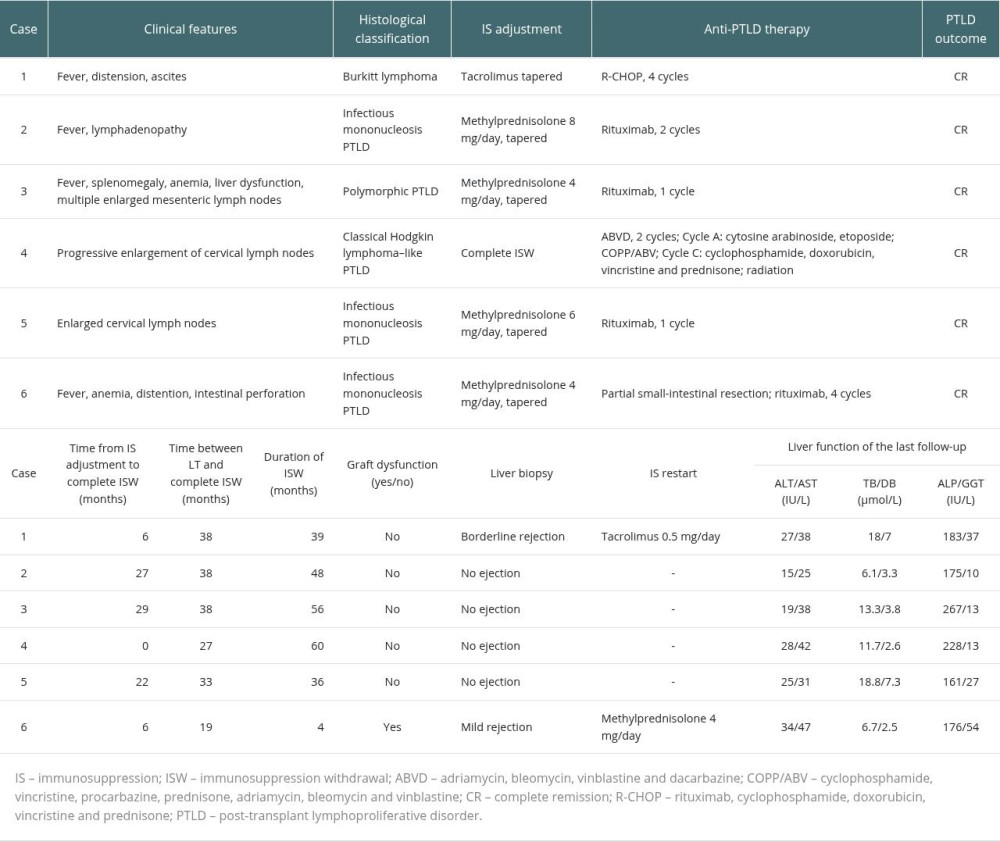
The 6 patients presented with clinical features including fever, lymphadenopathy, anemia, hypoproteinemia, hepatosplenomegaly, and various gastrointestinal manifestations (eg, abdominal pain, diarrhea, ascites, or intestinal perforation) (Table 2). Histologic classification of PTLD was infectious mononucleosis-type in 3 patients, polymorphic in 1 patient, Burkitt lymphoma in 1 patient, and classical Hodgkin lymphoma–like PTLD in 1 patient.
All patients underwent reduction or discontinuation of immunosuppression as part of PTLD therapy. Four patients (3 with infectious mononucleosis-type PTLD and 1 with polymorphic PTLD) received rituximab (anti-CD20) therapy. One of these patients (case 6) required a partial small-intestinal resection because of intestinal perforation. The patient with Burkitt lymphoma (case 1) was treated with R-CHOP chemotherapy (rituximab, cyclophosphamide, doxorubicin, vincristine, prednisone). The patient with Hodgkin-like PTLD (case 4) was initially treated with 2 cycles of ABVD chemotherapy (adriamycin, bleomycin, vinblastine, dacarbazine). Because this regimen failed to achieve remission, therapy was escalated to a more intensive multi-agent regimen (including cytarabine, etoposide, cyclophosphamide, doxorubicin, vincristine, procarbazine, and prednisone) combined with radiotherapy. All 6 patients ultimately achieved complete remission following these treatments.
ISW AND GRAFT OUTCOMES:
The median interval from liver transplantation to complete ISW was 35 months (range 19–38). The duration from initiation of immunosuppression adjustment to complete ISW varied substantially among patients, ranging from 0 to 29 months (Table 2). Throughout the withdrawal process and during follow-up, graft status was closely monitored using serial liver function tests and protocol liver biopsies. During a median follow-up of 52 months after ISW, 4 of 6 patients maintained stable liver function without evidence of rejection (Figure 1).
Two patients developed rejection-related complications. In 1 patient (case 1), a protocol biopsy at 3 years after ISW revealed subclinical (borderline) rejection, characterized by mild portal inflammation and stromal C4d positivity (Figure 2). This patient was treated with low-dose tacrolimus (0.5 mg/day), after which graft function remained stable.
Another patient (case 6) developed biochemical graft dysfunction at 4 months after ISW. Liver biopsy demonstrated mild acute cellular rejection (Banff score 4) with stromal C4d positivity (Figure 3). Following reintroduction of immunosuppression with methylprednisolone (4 mg/day), liver enzyme levels normalized and graft function recovered. A repeat liver biopsy performed more than 1 year later revealed no evidence of rejection. Notably, no patient experienced graft loss, and no recurrence of PTLD was observed during follow-up.
Discussion
In this study, we found that complete withdrawal of maintenance immunosuppression was feasible in a carefully selected cohort of pediatric liver transplant recipients with PTLD, without irreversible graft injury in most cases. However, reversible rejection occurred in 2 patients, indicating that ISW carries a substantial risk of immune-mediated graft injury. These findings underscore the importance of rigorous biochemical and histological monitoring to allow early detection and timely treatment of rejection during and after ISW.
Our observations align with prior reports that only a minority of pediatric liver transplant recipients can achieve operational tolerance [10]. The liver is considered a relatively tolerogenic organ, and operational tolerance has been reported more frequently after liver transplantation than after other solid organ transplants. Previous studies have identified factors associated with successful ISW, such as young recipient age, living donor grafts, a prolonged posttransplant interval before withdrawal, and no history of rejection[9]. The favorable profile of our cohort across these parameters likely contributed to the relatively high success rate in achieving stable graft function. Unlike many ISW series in unselected recipients, our cohort consisted entirely of patients with PTLD, adding a unique context to these established favorable factors.
PTLD is recognized as a potentially life-threatening complication after liver transplantation. Calcineurin inhibitors (CNIs), such as tacrolimus, are known risk factors for PTLD development [8]. Adjusting immunosuppressive therapy, including reducing or discontinuing CNIs, is a standard component of PTLD management. In our study, all patients underwent immunosuppression reduction as part of their initial PTLD treatment. This strategy not only addressed the malignancy but also set the stage for eventual tolerance, as reducing CNI exposure may lessen oncogenic stimuli and promote immune regulation over time.
Operational tolerance occurs more frequently in liver transplantation than in other solid organ transplants, particularly in pediatric recipients. Predictive factors include younger patient age at transplant and the use of living-related donor grafts [13]. Our cohort, predominantly consisting of living donor grafts, may have benefited from the associated genetic similarity or favorable immunologic matching, which could promote tolerance. The interval between transplant and ISW initiation in our patients was substantial, consistent with the notion that longer engraftment time before withdrawal favors tolerance [11].
Histologic features may also inform graft tolerance status. Previous studies have shown that even mild portal inflammation or C4d deposition in biopsies can predict loss of tolerance [14]. In our cohort, surveillance biopsies from 2 patients revealed mild portal inflammation with stromal C4d positivity during the withdrawal period, suggesting subclinical immune activation despite overall graft stability. The dynamic nature of tolerance is illustrated by the patient in case 1 who had normal histology at 1 year after ISW but developed borderline rejection by year 3. This observation emphasizes that operational tolerance may not be permanent and reinforces the value of periodic biopsies even in the absence of laboratory abnormalities, as tolerance can be reversible [15]. Early histologic detection in our patients allowed prompt intervention before significant injury occurred, leading to full recovery of graft function. These experiences highlight that the potential benefit of ISW must be weighed against the necessity of being able to promptly reverse graft injury. Importantly, previous studies have demonstrated that grafts in operationally tolerant liver transplant recipients may develop progressive fibrosis despite normal liver biochemical parameters. In this context, protocol liver biopsy plays a critical role in the long-term surveillance of graft integrity, allowing early detection of fibrosis or immune-mediated injury even in clinically stable patients.
Efforts to identify biomarkers of tolerance are ongoing. While certain peripheral blood gene expression signatures have been linked to tolerant states, no universally reliable biomarker currently exists [16,17]. All patients in our cohort had EBV-positive PTLD and most received rituximab. It is conceivable that B-cell depletion induced by rituximab contributed to an immunologic environment favoring graft tolerance, although this hypothesis requires further investigation [18]. Rituximab has been reported to potentially promote immune tolerance in other types of transplant patients, although the evidence remains limited and requires further validation through additional studies [19,20].
Importantly, operational tolerance should not be considered a permanent state, as immune activation can recur over time. Therefore, continued surveillance remains essential even in patients who successfully discontinue immunosuppression.
This study has several limitations. It is a retrospective review of a small, heterogeneous cohort from a single center, which limits generalizability. Because some transplants were performed during an earlier period, donor and recipient EBV serology data were not systematically available, and only EBV DNA viral load monitoring had been routinely performed. Moreover, the PTLD histologies and treatments varied, and we did not perform mechanistic immunologic studies. There is an inherent selection bias, as only patients judged to have very low rejection risk were offered ISW. Despite these limitations, our findings provide insight into the potential benefits and pitfalls of ISW in pediatric PTLD. Prospective multicenter studies are needed to better define which patients with PTLD may safely undergo ISW, optimize monitoring protocols, and identify noninvasive biomarkers of tolerance.
Conclusions
PTLD is a serious complication following pediatric liver transplantation. Reduction of immunosuppression remains a cornerstone of PTLD management, and in carefully selected patients, complete withdrawal can be achievable. Our findings suggest that supervised ISW can be performed in selected pediatric recipients without irreversible graft injury, although a risk of rejection persists. Careful patient selection, close clinical surveillance, and protocol liver biopsies are essential to ensure early detection and prompt management of rejection. Future studies are needed to refine selection criteria and identify biomarkers that may help guide safe ISW in this population.
Figures
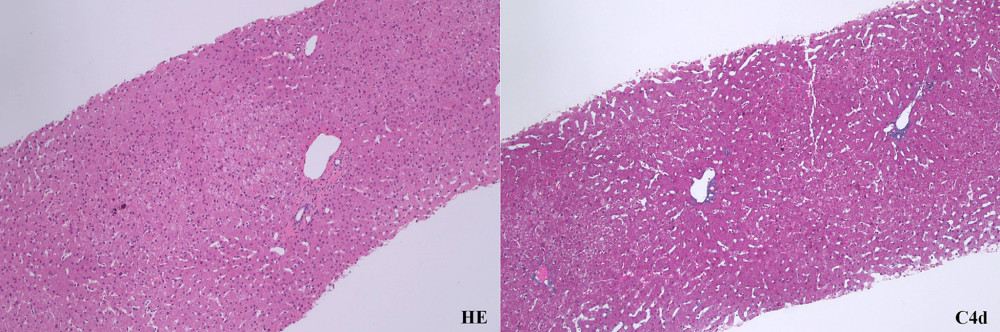 Figure 1. Liver biopsy in case 3 shows no evidence of rejection or graft fibrosis at 1 and 2 years after immunosuppression withdrawal.
 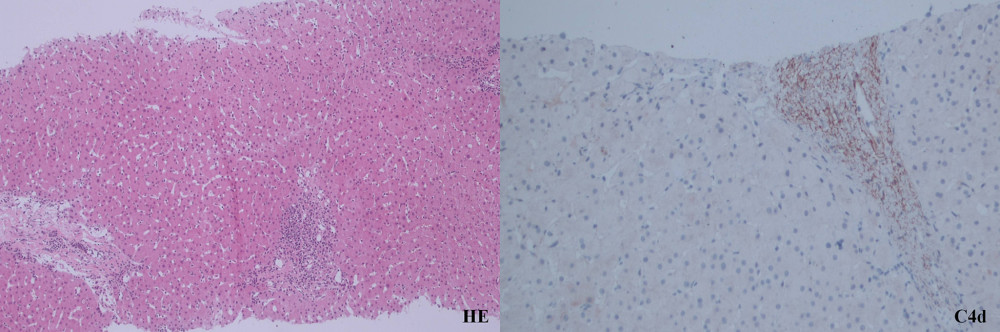 Figure 2. Liver biopsy in case 1 at 3 years after immunosuppression withdrawal shows a borderline rejection with stromal C4d positivity.
 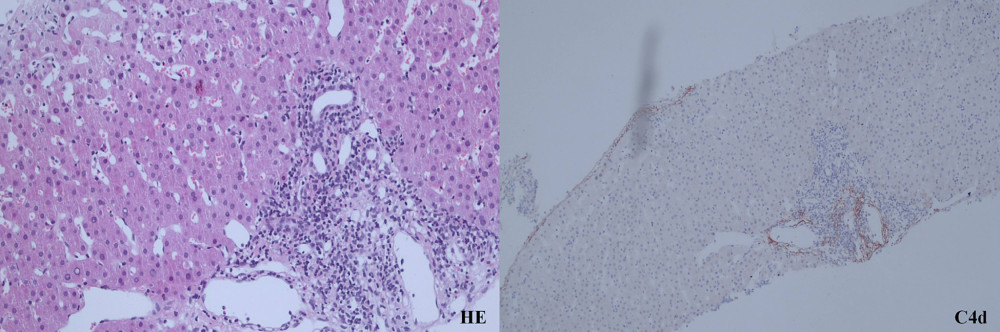 Figure 3. Liver biopsy shows mild rejection (Banff score=4) and C4d positivity in case 6 at 4 months after immunosuppression withdrawal.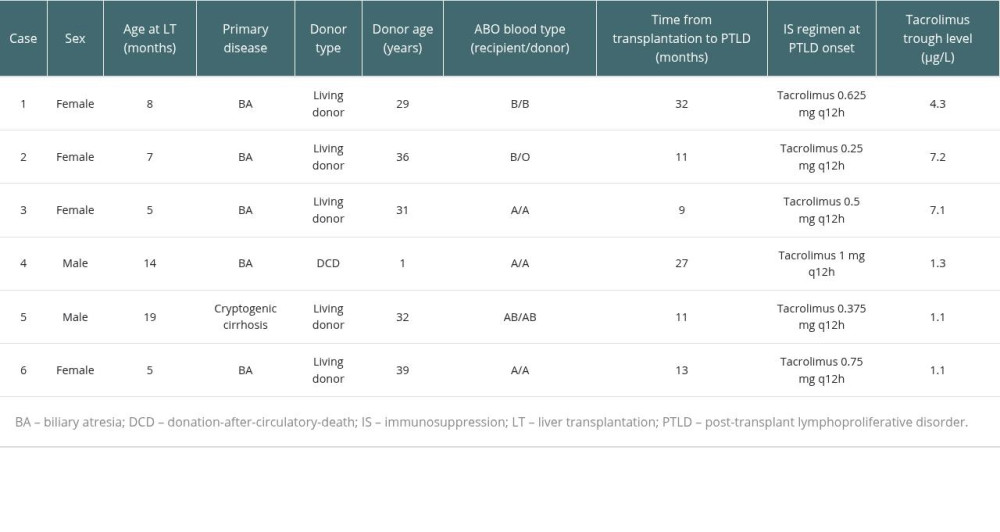
References
1. Baker A, Frauca Remacha E, Torres Canizales J, Current practices on diagnosis, prevention and treatment of post-transplant lymphoproliferative disorder in pediatric patients after solid organ transplantation: Results of ERN TransplantChild Healthcare Working Group Survey: Children (Basel, Switzerland), 2021; 8(8); 8080661
2. Belen Apak FB, Işik P, Olcay L, Posttransplant lymphoproliferative disorder in pediatric solid-organ transplant recipients: A 7-year single-center analysis: Exp Clin Transplant, 2024; 22(Suppl 5); 35-40
3. Tajima T, Hata K, Haga H, Post-transplant lymphoproliferative disorders after liver transplantation: A retrospective cohort study including 1954 transplants: Liver Transpl, 2021; 27(8); 1165-80
4. Amengual JE, Pro B, How I treat posttransplant lymphoproliferative disorder: Blood, 2023; 142(17); 1426-37
5. Allen UD, Preiksaitis JK, Post-transplant lymphoproliferative disorders, Epstein-Barr virus infection, and disease in solid organ transplantation: Guidelines from the American Society of Transplantation Infectious Diseases Community of Practice: Clinical transplantation, 2019; 33(9); e13652
6. Liu Y, Sun L-Y, Zhu Z-J, Post-transplant lymphoproliferative disorder after paediatric liver transplantation: Int J Clin Pract, 2020; 75(4); e13843
7. El-Mallawany NK, Rouce RH, EBV and post-transplant lymphoproliferative disorder: A complex relationship: Hematology Am Soc Hematol Educ Program, 2024; 2024(1); 728-35
8. Dierickx D, Habermann TM, Post-transplantation lymphoproliferative disorders in adults: N Engl J Med, 2018; 378(6); 549-62
9. Feng S, Bucuvalas JC, Mazariegos GV, Efficacy and safety of immunosuppression withdrawal in pediatric liver transplant recipients: Moving toward personalized management: Hepatology, 2021; 73(5); 1985-2004
10. Shaked A, DesMarais MR, Kopetskie H, Outcomes of immunosuppression minimization and withdrawal early after liver transplantation: Am J Transplant, 2018; 19(5); 1397-409
11. Feng S, Ekong UD, Lobritto SJ, Complete immunosuppression withdrawal and subsequent allograft function among pediatric recipients of parental living donor liver transplants: JAMA, 2012; 307(3); 283-93
12. Swerdlow SH, Campo E, Pileri SA, The 2016 revision of the World Health Organization classification of lymphoid neoplasms: Blood, 2016; 127(20); 2375-90
13. Kamran Hejazi Kenari S, Mirzakhani H, Saidi RF, Pediatric transplantation and tolerance: Past, present, and future: Pediatr Transplant, 2014; 18(5); 435-45
14. Vionnet J, Sánchez-Fueyo A, Biomarkers of operational tolerance after liver transplantation: Are we there yet? Liver transplantation: official publication of the American Association for the Study of Liver Diseases and the International Liver Transpl, 2021; 28(1); 15-16
15. Wozniak LJ, Venick RS, Naini BV, Operational tolerance is not always permanent: A 10-year prospective study in pediatric liver transplantation recipients: Liver Transpl, 2022; 28(10); 1640-50
16. Montano-Loza AJ, Rodríguez-Perálvarez ML, Pageaux G-P, Liver transplantation immunology: Immunosuppression, rejection, and immunomodulation: J Hepatol, 2023; 78(6); 1199-215
17. Appenzeller-Herzog C, Hartleif S, Vionnet J, Clinical parameters and biomarkers predicting spontaneous operational tolerance after liver transplantation: A scoping review: Am J Transplant, 2021; 21(10); 3312-23
18. Yamada M, L’Huillier AG, Green M, A focused review of epstein-barr virus infections and PTLD in pediatric transplant recipients: Guidance from the IPTA and ECIL guidelines: J Pediat Infect Dis Soc, 2024; 13(Suppl 1); S31-S8
19. Dharnidharka VR, Ruzinova MB, Marks LJ, Post-transplant lymphoproliferative disorders: Semin Nephrol, 2024; 44(1); 151503
20. Socié G, Barba P, Barlev A, Sanz J, Outcomes for patients with EBV-positive PTLD post-allogeneic HCT after failure of rituximab-containing therapy: Bone Marrow Transplant, 2024; 59(1); 52-58
Figures
Figure 1. Liver biopsy in case 3 shows no evidence of rejection or graft fibrosis at 1 and 2 years after immunosuppression withdrawal.Figure 2. Liver biopsy in case 1 at 3 years after immunosuppression withdrawal shows a borderline rejection with stromal C4d positivity.Figure 3. Liver biopsy shows mild rejection (Banff score=4) and C4d positivity in case 6 at 4 months after immunosuppression withdrawal. Tables
In Press
Original article
Fundamental Strategies and Technical Perspectives in Bile Duct Anastomosis for Living Donor Liver Transplan...Ann Transplant In Press; DOI: 10.12659/AOT.953761
Clinical Research
Retrospective Study of Implementation and Outcomes of a Non-Cryopreserved Autologous Hematopoietic Stem Cel...Ann Transplant In Press; DOI: 10.12659/AOT.954230
Clinical Research
Prognostic Prediction in Living Donor Liver Transplantation Recipients With Complete Pathological Response ...Ann Transplant In Press; DOI: 10.12659/AOT.954574
Most Viewed Current Articles
24 Aug 2021 : Review article 21,978
Normothermic Machine Perfusion (NMP) of the Liver – Current Status and Future PerspectivesDOI :10.12659/AOT.931664
Ann Transplant 2021; 26:e931664
29 Dec 2021 : Original article 18,247
Efficacy and Safety of Tacrolimus-Based Maintenance Regimens in De Novo Kidney Transplant Recipients: A Sys...DOI :10.12659/AOT.933588
Ann Transplant 2021; 26:e933588
22 Nov 2022 : Original article 16,856
Long-Term Effects of Everolimus-Facilitated Tacrolimus Reduction in Living-Donor Liver Transplant Recipient...DOI :10.12659/AOT.937988
Ann Transplant 2022; 27:e937988
05 Apr 2022 : Original article 16,762
Impact of Statins on Hepatocellular Carcinoma Recurrence After Living-Donor Liver TransplantationDOI :10.12659/AOT.935604
Ann Transplant 2022; 27:e935604