


25 August 2026: Original Paper
Common Versus External Iliac Arterial Anastomosis in Kidney Transplantation: A Bicentric Retrospective Analysis of Vascular Complications and Graft Outcomes
Gaël Saint Jalmes ABCDEF 1, Matthias Buchler B 2, Jean Picquet B 3, Jean François Augusto B 4, Thibaut Culty  B 1, Souhil Lebdai BE 1, Franck Bruyere A 5, Pierre Bigot BDEG 1*
DOI: 10.12659/AOT.953269
Ann Transplant 2026; 31:e953269


Abstract
BACKGROUND: Vascular complications remain a significant concern after kidney transplantation. While external iliac (EI) implantation is standard, common iliac (CI) implantation is occasionally performed in selected cases, particularly in the presence of vascular disease or anatomical constraints. We compared vascular outcomes according to the arterial anastomosis site.
MATERIAL AND METHODS: We conducted a bicentric retrospective study including kidney transplant recipients between 2015 and 2019. Implantation strategy differed between centers, with a preferential use of CI implantation in one center and EI implantation in the other. Patients underwent arterial anastomosis to the CI (n=157) or EI vessels (n=359). The primary endpoint was vascular complications graded according to the Clavien–Dindo classification. Secondary endpoints included ≥60% vascular stenosis, lymphocele rate, and graft failure at 2 years.
RESULTS: Baseline characteristics differed between groups, reflecting center-specific practices and case-mix variations. Overall vascular complication rates were similar (22.9% in CI vs 20.1% in EI; P=0.46). However, Clavien–Dindo ≥III complications were more frequent in the CI group (14.6% vs 7.5%; P=0.01). Severe vascular stenosis requiring intervention (Clavien–Dindo III) occurred more often in CI recipients (7.0% vs 0.8%; P<0.01). Lymphocele was also significantly more frequent in the CI group (27.4% vs 9.2%; P<0.01; OR 4.55, 95% CI 2.56-8.09; P<0.001). At 2 years, graft failure rates did not differ significantly (4.1% vs 5.3%; P=0.29).
CONCLUSIONS: In this bicentric retrospective analysis, CI implantation was associated with a higher rate of severe vascular complications, particularly stenosis, and lymphocele, without a significant impact on graft failure at 2 years. These findings should be interpreted with caution, as they likely reflect, at least in part, differences in patient selection and center-specific surgical practices.
Keywords: Kidney Transplantation, Vascular Surgical Procedures, Lymphocele
Introduction
Kidney transplantation is the standard treatment for end-stage renal disease. However, this surgical procedure can be complicated by vascular events, with reported rates ranging from 1% to 23% [1]. In the largest published cohort to date, Bessede et al analyzed 329 kidney transplants and reported an overall vascular complication rate of 13.5% [2]. These complications can result in impaired graft function and, in severe cases, premature graft loss [3].
In routine practice, vascular anastomoses are most commonly performed on the external iliac vessels (EI) [4]. Anastomosis on the common iliac vessels (CI) is typically reserved for pediatric transplantation or re-transplantation, particularly third grafts. However, the choice of implantation site may also reflect local surgical preference and center-specific practice patterns, which should be considered when interpreting comparative outcomes. Nevertheless, some surgical teams favor the common iliac vessels even in first kidney transplantation, avoiding the external iliac axis because of concerns related to vessel mobility.
The external iliac artery is exposed to repetitive mobilization during hip flexion and extension, which could potentially lead to microtrauma at the anastomotic site. In support of this hypothesis, external iliac artery stenosis has been described in high-level cyclists, attributed to endofibrotic lesions induced by repeated mechanical stress on this arterial segment [5]. More broadly, vascular complications after kidney transplantation remain influenced by both anatomical factors and technical considerations, including the choice of implantation site.
To date, only 1 study has specifically compared vascular complication rates according to the arterial implantation site. In a cohort of 312 kidney transplant recipients, transplantation on the common iliac vessels was associated with a lower risk of vascular complications, with an odds ratio of 0.4 compared to transplants performed on the external iliac vessels [6]. However, evidence remains limited, and the potential impact of institutional practices on these outcomes has not been fully explored.
Therefore, the aim of the present study was to compare vascular complication rates between kidney transplant recipients with arterial implantation on the common iliac vessels and those implanted on the external iliac vessels.
Material and Methods
STUDY DESIGN AND STUDY POPULATION:
We conducted a bicentric, retrospective cohort study at Angers University Hospital and Tours University Hospital (France). All adult patients who underwent kidney transplantation between January 2015 and December 2019 were eligible for inclusion. This retrospective study was approved by the institutional review board/ethics committee of both participating centers. Patients were informed of the use of their data and did not object, in accordance with local regulations.
EXCLUSION CRITERIA:
Patients were excluded if they underwent any of the following: dual kidney transplantation (en bloc or bilateral transplantation), multiorgan transplantation, cystectomy with Bricker-type urinary diversion, pediatric transplantation, and kidney transplantation using a non-standard surgical technique (eg, robot-assisted approach or alternative technique). Perioperative anesthetic complications unrelated to the surgical procedure were not considered study outcomes.
SURGICAL STRATEGY AND IMPLANTATION SITE:
Patients were divided into 2 groups according to the arterial implantation site: common iliac (CI) versus external iliac (EI) vessels. Arterial anastomoses were performed using standard techniques, with continuous polypropylene sutures (5-0 or 6-0), according to surgeon preference. No major differences in anastomotic technique were identified between centers.
At Angers University Hospital, transplantation was performed by urologists and vascular surgeons. Within the urology team, procedures were performed by senior surgeons, while within the vascular surgery team, procedures were performed by both junior and senior surgeons. At this center, arterial anastomosis to the common iliac artery was used as the first-line strategy, in accordance with the findings reported by Ammi et al [6].
At Tours University Hospital, transplantation was performed exclusively by urologists (junior and senior surgeons). Arterial anastomosis was performed on the external iliac artery using the standard reference technique [4]. As implantation strategy differed between centers, with a preferential use of CI implantation in Angers and EI implantation in Tours, the comparison between groups partly reflects center-specific practices and surgeon profiles, which may introduce selection bias.
OUTCOMES AND DEFINITIONS:
The primary outcome was the rate of vascular complications within 2 years after transplantation, graded according to the Clavien–Dindo classification [7]. For the primary analysis, all vascular complications (Clavien–Dindo grades I–V) were considered, with a secondary focus on severe complications defined as grade ≥ III. Postoperative follow-up and surveillance protocols, including Doppler ultrasound assessment, were comparable between centers and were performed according to standard clinical practice.
Secondary outcomes included arterial anastomotic stenosis, lymphocele rate, graft survival at 2 years, and renal function at 2 years.
Complications were retrospectively collected from hospitalization reports, operative reports, and outpatient follow-up visits during the first 2 years after transplantation. Arterial stenosis was diagnosed by Doppler ultrasound in both centers and was defined as a peak systolic velocity > 190 cm/s.
Clavien–Dindo grades I–II included complications requiring no intervention or only pharmacological treatment. Grade IIIa corresponded to percutaneous intervention without general anesthesia, whereas grade IIIb required surgical intervention under general anesthesia without immediate graft loss. Grade IV included complications leading to immediate graft failure requiring dialysis and/or acute limb ischemia. Grade V corresponded to patient death.
SAMPLE SIZE CALCULATION:
Based on previous publications, vascular complication rates were estimated at 7.5% for CI implantation [6] and 11.9% for EI implantation [2]. We hypothesized complication rates of 7.5% in the CI group and 14% in the EI group. With a power of 80% and a 2-sided alpha of 0.05, the estimated sample size required was 712 patients (359 per group). The final sample size was lower than initially estimated, which may have reduced the statistical power of the study.
STATISTICAL ANALYSIS:
A 2-sided
Results
STUDY POPULATION:
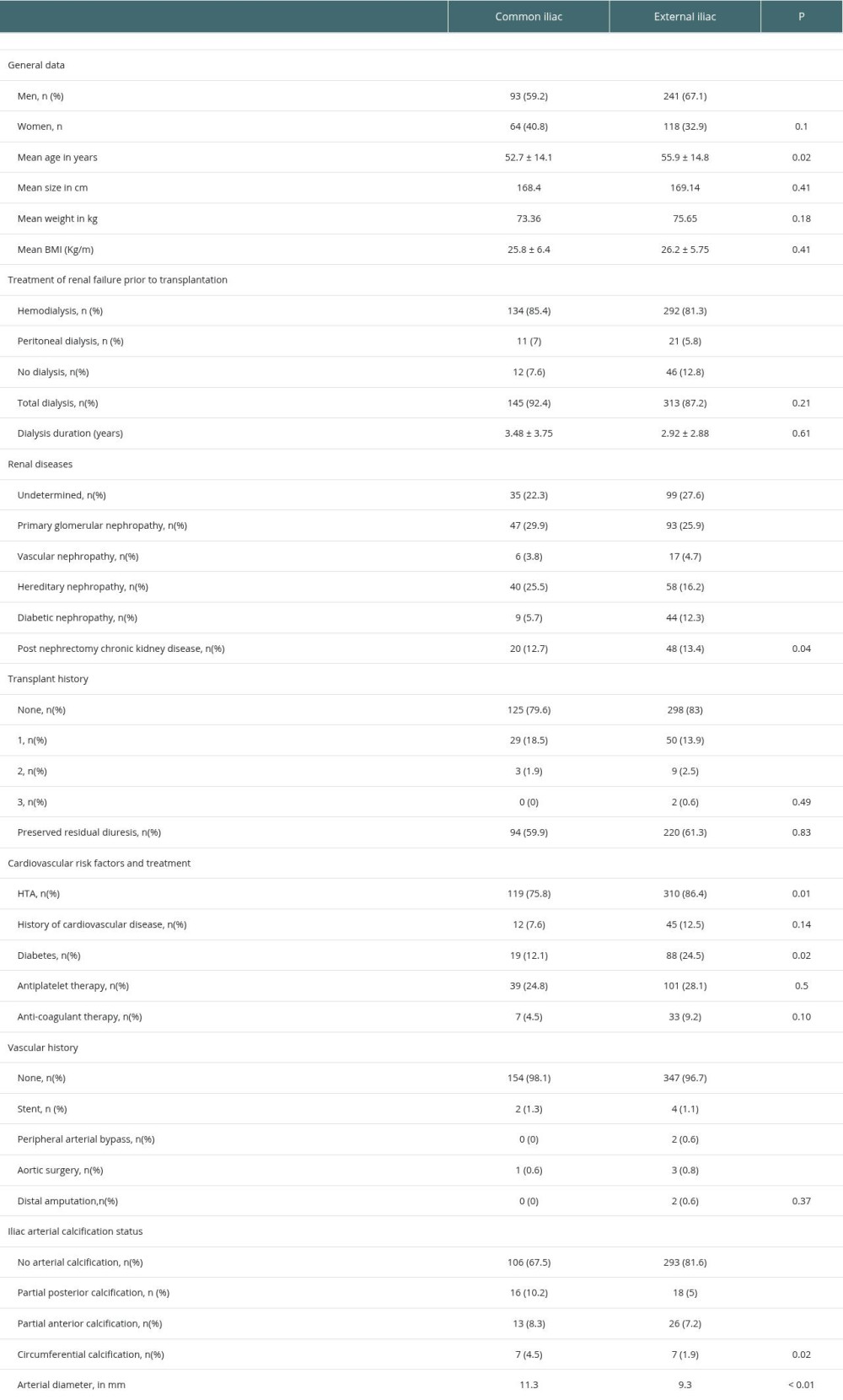
A total of 636 patients were screened. In the CI group, 239 patients were assessed and 82 were excluded. In the EI group, 397 patients were assessed and 38 were excluded. The final study population included 157 patients in the CI group and 359 in the EI group. In the CI group, 85.4% of transplantations were performed by vascular surgeons and 14.6% by urologists. In the EI group, all transplantations were performed by urologists. Baseline recipient characteristics differed between groups (Table 1). These differences likely reflect, at least in part, center-specific practices and patient selection. Recipients in the CI group were younger (52.7 vs 55.9 years, P = 0.02), had a higher proportion of polycystic kidney disease (25.5% vs 16.2%, P = 0.04), and more frequent arterial medial calcification of the recipient iliac axis (32.5% vs 18.4%, P = 0.02). In contrast, recipients in the EI group more frequently had hypertension (86.4% vs 75.8%, P = 0.01) and diabetes (24.5% vs 12.1%, P = 0.02). Donor and graft characteristics also differed between groups. Donors were younger in the CI group (53.4 vs 56.8 years, P = 0.03), and donation after brain death was more frequent (89.8% vs 78.6%, P < 0.01). Donation after circulatory death (Maastricht III) and living donation were more frequent in the EI group (10.6% vs 6.4% and 10.9% vs 3.8%, respectively; P < 0.01). A non-pathological arterial patch was more frequently reported in the CI group (76.4% vs 68.5%, P < 0.01). Cold ischemia time and induction immunosuppressive regimens did not differ significantly between groups. In maintenance therapy, cyclosporine use was more frequent in the CI group (12.7% vs 0%, P < 0.01), whereas the tacrolimus–mycophenolate combination was less frequently used (77.1% vs 89.4%, P < 0.01).
PRIMARY OUTCOME: VASCULAR COMPLICATIONS:
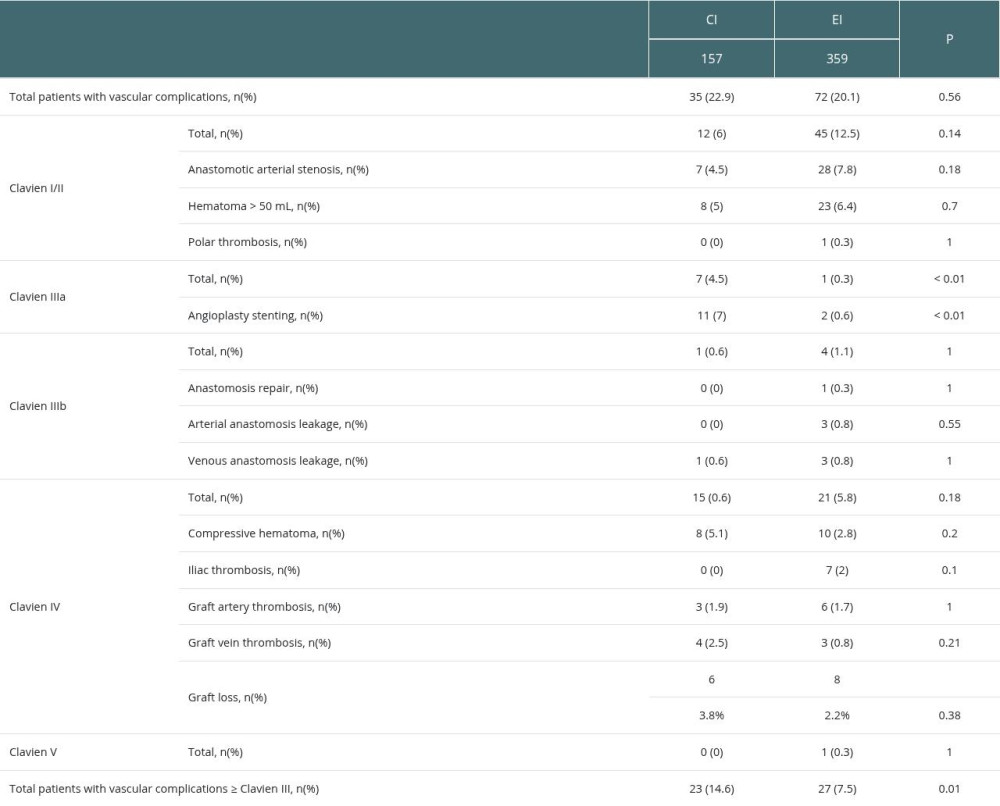
The overall rate of vascular complications within 2 years was not significantly different between the CI and EI groups (22.9% vs 20.1%, P = 0.56), across all Clavien–Dindo grades (I–V) (Table 2, detailed distribution by Clavien–Dindo grade). However, when stratified by Clavien–Dindo grade focusing on severe complications (≥ III), the CI group experienced more severe vascular complications, particularly grade IIIa complications (4.5% vs 0.3%, P < 0.01). CI implantation was associated with an increased risk of Clavien–Dindo ≥ III vascular complications in univariable analysis (OR 2.11, 95% CI 1.17–3.81, P = 0.01) and remained significant in multivariable analysis (OR 2.61, 95% CI 1.36–5.00, P < 0.001).
ARTERIAL ANASTOMOTIC STENOSIS:
Considering all grades, stenosis rates were not significantly different between the CI and EI groups (11.5% vs 8.6%,
LYMPHOCELE:
The lymphocele rate (all grades) was significantly higher in the CI group compared with the EI group (27.4% vs 9.2%,
GRAFT OUTCOMES AND RENAL FUNCTION:
At 2 years, graft loss rates were similar between groups (4.1% in the CI group vs 5.3% in the EI group,
Discussion
In our cohort, overall vascular complication rates were higher than those reported in the literature (22.9% and 20.1% vs 13.5% in Bessede et al) [2]. This difference may be explained by an overrepresentation of low-grade events, as hematoma and/or lymphocele were defined using an arbitrary threshold of 50 mL, potentially increasing the number of Clavien–Dindo grade I–II complications.
We did not identify several risk factors previously associated with arterial complications [8], such as multiple renal arteries, right-sided graft, sex, or recipient weight. This may reflect limited statistical power compared with larger registry-based studies. In contrast to Ammi et al, who reported common iliac implantation as a protective factor [6], our study did not confirm a decreased risk of overall vascular complications in the common iliac group. The relatively small number of recipients transplanted on the common iliac vessels may have contributed to this discrepancy.
Overall stenosis rates were in line with previously published data, including a large American cohort reporting an 8.3% incidence [9]. However, stenosis may have been underestimated, as systematic Doppler surveillance was performed only during the first year, whereas stenosis may occur up to 2 years after transplantation. Importantly, common iliac implantation was associated with a higher incidence of severe stenosis requiring intervention, and absence of an arterial patch was independently associated with anastomotic stenosis. These findings have not been consistently reported in previous studies [10–12]. A deeper operative field and more frequent iliac medial calcification may contribute to higher technical complexity during common iliac anastomosis. Unfortunately, data on warm ischemia time and operative time were not systematically available and could not be analyzed.
One of the most notable findings of our study was the significantly higher lymphocele rate in the common iliac group. This outcome was not evaluated by Ammi et al [6] and has rarely been analyzed according to implantation site. Sansalone et al reported a lower lymphocele rate in common iliac implantation, possibly related to differences in surgical exposure and lymphatic control [13]. In our cohort, cyclosporine–mycophenolate use was associated with lymphocele occurrence, consistent with previous reports showing higher lymphocele rates under cyclosporine compared with tacrolimus [14]. Although the underlying mechanism remains unclear, cyclosporine has previously been associated with impaired tissue healing and persistent postoperative lymphatic leakage or fluid collection, which may contribute to lymphocele formation. In addition, cyclosporine use may also reflect older immunosuppressive protocols and historical transplantation protocols. Graft-related mechanisms may also contribute, as lymphocele fluid has been shown to be predominantly graft-derived [15].
At 2 years, graft loss rates were similar between groups, while eGFR appeared higher after common iliac implantation. This difference likely reflects donor-related factors, particularly younger donor age, which is a well-established determinant of graft function [16]. In multivariable analysis, donor age, recipient BMI, and Clavien–Dindo grade IV complications were associated with poorer renal function recovery, whereas implantation site was no longer independently associated with eGFR at 2 years [2,17].
These findings should be interpreted with caution. The choice of implantation site was strongly associated with center-specific practices and surgeon experience, and the comparison between groups therefore partly reflects institutional strategies rather than the isolated effect of implantation site. In addition, baseline differences between groups and the absence of adjustment for center effect may have introduced residual confounding. Accordingly, the associations observed in this study should be regarded as observational rather than causal.
Other limitations include the retrospective design, the relatively small number of patients in the common iliac group, and the lack of adjustment for key post-transplant factors such as immunological events and viral infections [18]. Future studies using larger multicenter cohorts and advanced statistical methods, such as propensity-score approaches, may help better determine the independent impact of arterial implantation site on postoperative outcomes.
Conclusions
In this bicentric retrospective study, kidney transplantation with arterial anastomosis to the common iliac vessels was not associated with a higher overall rate of vascular complications compared with external iliac implantation. However, common iliac implantation was associated with higher rates of severe (Clavien–Dindo ≥ III) complications, particularly vascular stenosis requiring intervention, as well as a markedly higher lymphocele rate. These findings should be interpreted cautiously given the retrospective design, center-specific surgical practices, and baseline differences between groups. Despite these differences, 2-year graft survival was similar between groups. Further studies with improved adjustment for surgical complexity, center effect, and baseline characteristics are warranted to better assess the independent effect of implantation site on postoperative outcomes.
References
1. White-Dzuro CE, Geanon DJ, Fagel BM, Vascular and lymphatic complications after renal transplant: Abdom Radiol (NY), 2025; 50(12); 6085-105
2. Bessede T, Droupy S, Hammoudi Y, Surgical prevention and management of vascular complications of kidney transplantation: Transpl Int, 2012; 25(9); 994-1001
3. Zhang J, Xue W, Tian P, Diagnostic and therapeutic strategies for vascular complications after renal transplantation: A single-center experience in 2,304 renal transplantations: Front Transplant, 2023; 2; 1150331
4. Masson E, EM-Consulte: Aspects chirurgicaux de la transplantation rénale chez l’homme [in French]https://www.em-consulte.com/article/1284157/aspects-chirurgicaux-de-la-transplantation-renale-
5. Abraham P, Saumet JL, Chevalier JM, External iliac artery endofibrosis in athletes: Sports Med Auckl NZ, 1997; 24(4); 221-26
6. Ammi M, Daligault M, Sayegh J, Evaluation of the vascular surgical complications of renal transplantation: Ann Vasc Surg, 2016; 33; 23-30
7. Dindo D, Demartines N, Clavien PA, Classification of surgical complications: A new proposal with evaluation in a cohort of 6336 patients and results of a survey: Ann Surg, 2004; 240(2); 205-13
8. Yamanaka K, Kakuta Y, Nakazawa S, Surgical and infectious complications following kidney transplantation: A contemporary review: J Clin Med, 2025; 14(10); 3307
9. Hurst FP, Abbott KC, Neff RT, Incidence, predictors and outcomes of transplant renal artery stenosis after kidney transplantation: Analysis of USRDS: Am J Nephrol, 2009; 30(5); 459-67
10. Nicholson ML, Yong C, Trotter PB, Risk factors for transplant renal artery stenosis after live donor transplantation: Br J Surg, 2019; 106(3); 199-205
11. Benedetti E, Troppmann C, Gillingham K, Short- and long-term outcomes of kidney transplants with multiple renal arteries: Ann Surg, 1995; 221(4); 406-14
12. Rijkse E, van Dam JL, Roodnat JI, The prognosis of kidney transplant recipients with aorto-iliac calcification: A systematic review and meta-analysis: Transpl Int, 2020; 33(5); 483-96
13. Sansalone CV, Aseni P, Minetti E, Is lymphocele in renal transplantation an avoidable complication?: Am J Surg, 2000; 179(3); 182-85
14. Lehner LJ, Hohberger A, Marschke L, Analysis of risk factors and long-term outcomes in kidney transplant patients with identified lymphoceles: J Clin Med, 2020; 9(9); 2841
15. Pacovsky J, Hyspler R, Navratil P, The estimation of post-transplant lymphocele origin using creatine kinase activity: Ups J Med Sci, 2010; 115(3); 187-92
16. Lebranchu Y, Halimi JM, Bock A, Delayed graft function: Risk factors, consequences and parameters affecting outcome-results from MOST, A Multinational Observational Study: Transplant Proc, 2005; 37(1); 345-47
17. Liese J, Bottner N, Büttner S, Influence of the recipient body mass index on the outcomes after kidney transplantation: Langenbecks Arch Surg, 2018; 403(1); 73-82
18. Seo CH, Ju JI, Kim MH, Risk factors and long-term outcomes of delayed graft function in deceased donor renal transplantation: Ann Surg Treat Res, 2015; 89(4); 208-14
In Press
Original article
Role of Psychological Resilience on Emotional Health in Kidney and Liver Transplant RecipientsAnn Transplant In Press; DOI: 10.12659/AOT.952824
Original article
Analysis of Factors Influencing the Psychological State of Patients After Autologous Liver TransplantationAnn Transplant In Press; DOI: 10.12659/AOT.953645
Original article
Fundamental Strategies and Technical Perspectives in Bile Duct Anastomosis for Living Donor Liver Transplan...Ann Transplant In Press; DOI: 10.12659/AOT.953761
Clinical Research
Retrospective Study of Implementation and Outcomes of a Non-Cryopreserved Autologous Hematopoietic Stem Cel...Ann Transplant In Press; DOI: 10.12659/AOT.954230
Most Viewed Current Articles
24 Aug 2021 : Review article 21,797
Normothermic Machine Perfusion (NMP) of the Liver – Current Status and Future PerspectivesDOI :10.12659/AOT.931664
Ann Transplant 2021; 26:e931664
29 Dec 2021 : Original article 18,052
Efficacy and Safety of Tacrolimus-Based Maintenance Regimens in De Novo Kidney Transplant Recipients: A Sys...DOI :10.12659/AOT.933588
Ann Transplant 2021; 26:e933588
22 Nov 2022 : Original article 16,749
Long-Term Effects of Everolimus-Facilitated Tacrolimus Reduction in Living-Donor Liver Transplant Recipient...DOI :10.12659/AOT.937988
Ann Transplant 2022; 27:e937988
05 Apr 2022 : Original article 16,654
Impact of Statins on Hepatocellular Carcinoma Recurrence After Living-Donor Liver TransplantationDOI :10.12659/AOT.935604
Ann Transplant 2022; 27:e935604